 +1987 123456
 info@domain.com
 Rock Street, San Francisco


Let’s face it: the days of paying an influencer $500 just to hold your product and smile are officially over.
If you’re a marketing manager in Toronto or Vancouver staring at your 2026 budget, you’ve probably noticed a seismic shift. Canadian consumers aren’t just “scrolling” anymore—they’re hunting. They’ve moved from traditional search engines to discovery via creators.
And the numbers back this up. The Canadian influencer platform market is projected to reach $4.15 billion by 2030, riding a massive CAGR of 22.7% starting right now.
But here’s the kicker: In 2026, influencer marketing in Canada isn’t about “awareness” or “vanity metrics.” It’s become a full-funnel performance channel. If you aren’t adapting to the new “Hybrid Model” of compensation and strict new Ad Standards, you’re already falling behind.
Here is the no-fluff breakdown of the statistics, trends, and regulations shaping Canadian influencer marketing in 2026.
The State of the Industry: Key Canadian Statistics (2025-2026)
If you need hard numbers to justify your budget to the CFO, start here. The data shows a clear migration of capital from traditional media to the creator economy.
Market Size and Budget Growth
The “experimentation phase” is finished. We are seeing a massive consolidation of spend:
- 62% of marketers are increasing their influencer budgets in 2026.
- Nearly two-thirds of Canadian brands are actively reallocating funds away from traditional TV and Print to fuel creator partnerships.
- SME Growth: While large enterprises in Canada have always spent big, Small and Medium Enterprises (SMEs) are actually adopting influencers faster this year, driven by the need for hyper-local ROI that broad ads can’t deliver.
The Rise of “Social Commerce” in Canada
Canadians have historically been slower to adopt “shopping on social” compared to the US or Asia, but 2026 is the tipping point.
- 4 out of 10 consumers now purchase immediately after seeing an influencer recommendation.
- Direct checkout integrations (like TikTok Shop and YouTube Shopping) have become standard expectations for Canadian buyers. If they have to click three times to find the product on your site, you’ve lost them.
2026 Trend: The Shift from “Vanity Metrics” to “Performance Marketing”
Remember when we used to celebrate a post getting 5,000 likes? That doesn’t pay the bills. The biggest strategic shift for 2026 is the death of the “Follower Count” as a primary metric.
ROI Over Reach
Brands are ditching reach for Cost Per Acquisition (CPA) and Average Order Value (AOV).
Historically, 79% of marketers struggled to prove the ROI of their influencer campaigns. In 2026, the solution has been the mass adoption of Affiliate Integration.
The “Hybrid Model” is the New Standard
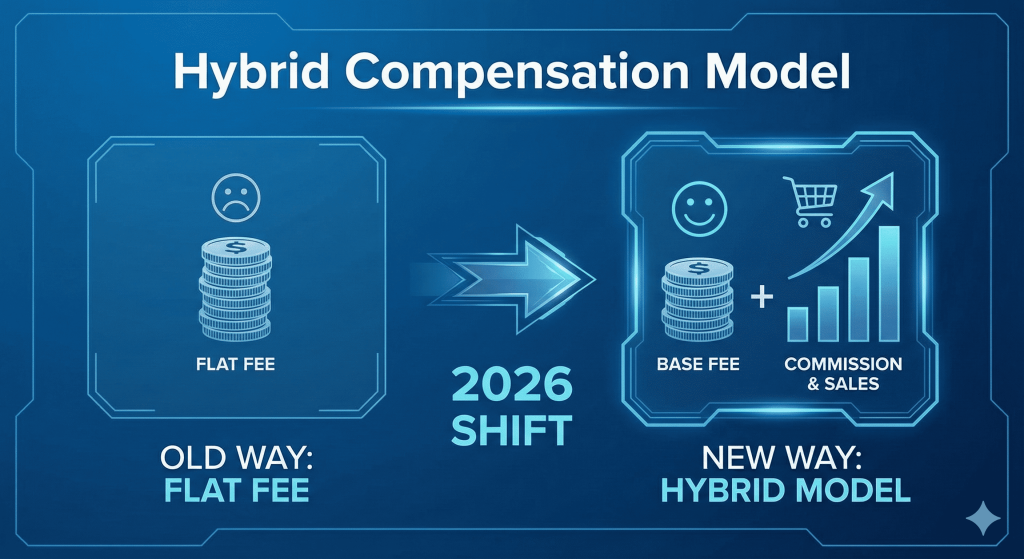
Smart Canadian brands are moving away from flat-fee “pay-and-pray” models. Instead, they are offering Hybrid Compensation:
- Base Fee: A smaller guaranteed amount to cover content production costs.
- Performance Kicker: A generous % commission on every sale driven via tracked links or codes.
This aligns incentives. If the creator’s content actually sells, they make more money than before. If it flops, your downside is protected.
The Dominance of Micro and Nano Influencers
Bigger isn’t better—better is better.
- The Stat: Micro-influencers (10k-50k followers) now make up 47.3% of the active pool in Canada.
- Engagement Reality: Nano-influencers on TikTok are seeing engagement rates as high as 18%, compared to the sluggish 5% (or lower) seen by massive accounts.
Why Canada Loves Them: Canadians have a high “BS detector.” We prefer authentic, local voices—someone who actually shops at Loblaws or rides the TTC—over a massive US celebrity pretending to love a product they’ve never used.
Platform Breakdown: Where Canadians Are Spending Time
Not all screens are created equal. Here is where you need to put your dollars in 2026.
TikTok & YouTube Shorts (The Discovery Engines)
Short-form video is now the primary “Search Engine” for Gen Z and Millennials in Canada. People aren’t Googling “best winter moisturizer Canada”—they’re searching it on TikTok.
- SEO Angle: If your briefs don’t include “TikTok SEO” instructions (keywords in captions, text-on-screen, and voiceovers), you are invisible.
Instagram (The Conversion Engine)
Don’t count Instagram out. It still holds the largest share (42%+) for niche marketing, specifically in Beauty, Fashion, and Lifestyle.
- Pro Tip: While TikTok drives discovery, Instagram Stories are currently the top driver for direct link clicks for Canadian DTC brands.
LinkedIn (The B2B Sleeper Hit)
This is the biggest missed opportunity. We are seeing a surge in B2B influencer marketing for Canadian finance and tech sectors. leveraging industry experts to “influence” decision-makers is a strategy that is currently generating massive ROI with low competition.
The Regulatory Landscape: Ad Standards Canada Updates (Crucial)
If you skip this section, you put your brand at legal risk. Most generic articles only talk about the US FTC. But here in the Great White North, Ad Standards Canada dropped major updates in Fall 2025 that you need to enforce.
1. The “Gifted” Loophole is Closed
It used to be a gray area: if you sent a product for free but didn’t pay money, did the influencer have to disclose it? Now, the answer is a hard YES.
- Use of #GiftedProduct or #InvitedGuest is now required if there is a “material connection” (even if no cash changed hands).
2. New AI Disclosure Rules
With the explosion of GenAI, Ad Standards Canada now mandates transparency to prevent consumer deception.
- Virtual Influencers: If you use a CGI or AI-generated persona, it must be tagged (e.g., #AIinfluencer).
- AI-Gen Content: If an influencer uses AI to significantly alter their appearance or the product (like using AI to smooth skin in a skincare ad), it must be disclosed.
Challenges Facing Canadian Brands in 2026
It’s not all smooth sailing. Here are the hurdles you’ll need to jump.
The AI Trust Paradox
There is a strange contradiction happening right now.
- 74% of marketers love using AI for workflows (writing briefs, generating ideas, scripts).
- But 89% avoid virtual influencers entirely.
The Insight: Canadians value authenticity above all else. Using a “fake” human to sell a real product can backfire spectacularly and damage brand trust. Use AI to help your human creators, not to replace them.
Attribution Issues in a Cookie-less World
Tracking is harder than ever. The fix? First-Party Data collaborations. Brands are now asking influencers to share screenshots of their backend metrics or grant “Whitelisting” access to see the raw data, rather than relying on third-party scraping tools that are becoming less accurate.
Strategic Recommendations for Canadian CMOs
So, how do you win?
1. Localize, Don’t Just Duplicate
Don’t just take your US campaign and run it here. Use Canadian creators who understand local slang, geography, and culture. A campaign referencing “Target” (which doesn’t exist here anymore) immediately alienates a Canadian viewer.
2. Plan Ahead (Way Ahead)
The best creators are booked out months in advance. If you’re looking for Christmas marketing ideas or planning a Q4 push, you need to be locking in those relationships in Q2. Long-term “Brand Ambassador” contracts are replacing one-off posts because they build deeper trust over time.
3. Budget for “Whitelisting”
Stop hoping the algorithm favors you. Pay your top performing creators extra to run ads through their handles (Whitelisting). These ads consistently have a higher conversion rate than ads running from your corporate brand account because they look like organic content in the feed.
Conclusion: The Future is Decentralized
The era of the “billboard” is dead. In 2026, your brand is defined by what other people say about it, not what you say about yourself.
With the industry growing at a 22% CAGR, the brands that win will be the ones that treat creators not as hired guns, but as creative partners with shared revenue goals.
Audit your 2026 strategy today: Are you tracking Likes, or are you tracking Sales?

Leave a Reply